Thursday, June 1, 2017

The unexpected blessings of blogging daily

I blogged about Emmie, my little writing buddy.
A week ago, I decided to blog daily. Well, technically speaking, I set a goal of blogging every week day, but so far, I have posted something every day, even on the weekends. I had been neglecting my website blog lately, and I wanted to provide content on my Facebook author page. Thus, I made this goal: to post on my blog, then copy that post onto my Facebook author page daily.

Days one to three weren’t too bad. I just wrote about some things that were happening in my life, somewhat tied into writing. My background was journalism before I went into novel-writing, so it’s been fun to go back to writing short non-fiction pieces again. I also like taking photos so I use some of them for what amounts to photo-essays. By day four, however, I felt like I was running out of material. Thankfully, by the end of each day, I could usually come up with "something interesting" or “something I learned.”

My titles, so far:
-Saying yes…by saying no
-Why I didn’t write today
-My little writing buddy
-Breaking writer’s block
-A great day
-How to sprint through a manuscript
-A minimalist approach to creating

Blogging daily has blessed my life, and I wholeheartedly recommend this to those of you who want to establish a platform and strengthen your writing chops. Here are some things I have learned:
  1. It can be done.
  2. Not everything has to be earth-shattering, but surprisingly, my days have been more interesting than I expected.
  3. I became more observant so I could have material; I had more material because I was more observant.
  4. Once you commit the time, it is easier to maintain a daily blog than a sporadic blog.
  5. The daily habit of writing helped my other writing, too. It’s like priming the pump for my fiction.
  6. My Facebook author page followers liked or responded to my non-writing posts just as much, if not more, as my writing-related posts.
  7. On Facebook, I saw more engagement in terms of likes and people seeing my posts.
  8. I’ve had people share some of my what-I-learned writing posts.
  9. It’s fun to see what I can write. It’s like flash non-fiction.
  10. Adding photos (mine or I get free ones from pixabay.com) makes the post more appealing.
  11. Usually, I write in my journal (I type my entries on the computer), then use passages for my blog posts so I am not creating extra work.
Sometimes, I wonder if anyone reads my writing, or if a couple of likes is enough to justify spilling my guts out there for everyone to see. However, the way I see it, writing is transformative, not just for the reader, but for the writer. I’ll take the blessings how they come.

Tuesday, May 30, 2017

A Change of Scenery


Tonight after dinner, I walked over to Port Meadow to watch the sun retire. The same meadow that C.S. Lewis and J.R.R. Tolkien used to stroll together discussing their fairy tales. That’s right, I’m in Oxford England. Which brings me to my point; a change of scenery is refreshing and stimulating for a writer.

Obviously, we can’t all travel to our ideal writing environs. I am here for the spring term because my husband was granted a research fellow professorship at the Harris Manchester College at Oxford. My one stipulation was that I select our housing. No noisy-above-the-cafĂ©-downtown-Oxford for me! 

I found a renovated-near-ancient-shed on a lazy farm within Oxford city limits. I hadn’t a clue how idyllic it would be for creativity.

In one month I’ve written five children’s stories and more importantly, had a resurgence of pleasure and creativity while doing it. Hooray for the English countryside! Each day I stroll along the River Thames path serenaded by singing birds, squawking ducks, and geese. Ubiquitous Peter Rabbit bunnies and Hobbit shires line the trail.

Living here among the lush green rolling countryside has made me question whether someone got the promised land coordinates confused. Seriously, the worst thing about the English countryside is the stinging nettle. There aren’t even any mosquitoes here! Are you kidding me?

In the U.S. I dodge rattlesnakes, get frostbite, bunker down from tornadoes, worry about earthquakes, and navigate six lane freeways at rush hour.

Here I pedal my bike past ancient buildings, pick up a fresh loaf of walnut date bread from the bakery, a wedge of white cheddar from the cheese shop, and read books in a comfy chair in Blackwells (England’s premier bookstore).

Okay, I’ve made you jealous, I’m sorry. Just wanted to put in a plug for escaping your routine writing hub when possible and take a chance on revitalizing your creativity and pleasure.

Happy writing! 

Wednesday, May 3, 2017

Surviving a one-star review


My fourth published book and the second in my historical series, The Last Princess, came out Monday to fanfare: Facebook posts, an email to my newsletter subscribers, a tweet, an Instagram pic...and its first one-star review.

You spend hours, days, years, toiling over your book, and someone is bound to come along and say they didn't like it. Many people say they love reading your work but don't leave reviews; that one person who didn't...they take the time to write a review. Gah, is that frustrating, or what?

It hurt so much, I didn't write more of book 3 that afternoon, even though that had been my plan. Instead, I critiqued several pages for other people. It felt good; it allowed me to think of something else other than my own. After critiquing, I took solace in the fact that at least I got five-star reviews before the one-star came along.

But it still stung so badly. I admit, the review shook my confidence to my core.

I've written poetry and essays most of my professional life. I've always gotten great feedback on Facebook for my poetry. Heck, I've made people cry. But this fiction gig is by far the hardest I've done.

I like to think I can stitch along a good story. I have a good grasp of grammar and spelling. So why can't everyone just love everything that I write, and if they don't, to keep it to themselves? Um, because that isn't realistic? Thing is, by releasing a book to the wide world, without the safety net of "Facebook friend" connection, I am opening myself to criticism. It is an invitation for honest feedback.

Today, having recovered sufficiently from Monday, I planned on writing. Instead, as my first and third Wednesdays usually shape up, I had meetings, emails, and phone calls all day related to city council. (I am a councilwoman. Writing is not for the faint-hearted. Politics, too, but that's for another blog post.)

When my husband came home at four and I had only another free hour to write before a city work meeting, I lamented, "How can I write my bestselling book when I have to do xyz?"

The answer came to me just now. It is this: keep on writing.

It means I can learn from my reviews then square my shoulders. It means I should focus on the good (I got a book out, I finished a manuscript, I got a good review...Yay!) and not dwell on the negative. It means I should put my best work out there and write on despite what other people say.

Monday actually ended on a positive note. My son, who is serving an LDS mission in South Korea, emailed that evening. He wrote, God "has a plan for you, He knows how much good you can do, and He knows how much good you WANT to do. :) Keep on praying, keep on being obedient, and 'all things work together for good to them that love God.' " (Romans 8:28)

Amen.

Jewel Allen is an award-winning journalist, ghostwriter and author. Her latest novel is The Last Princess, set in 1760's Philippines, about an exiled Spanish captain who falls in love with the elusive Last Princess. Visit her at www.JewelAllen.com.

Thursday, April 6, 2017

If you don't like it...

Source: Pixabay
Forget world peace. Forget world hunger. I want to solve a serious problem today -- not getting Facebook likes from my siblings.

Yes, it is a most unfortunate situation. I have to tag them in my posts, and maybe, just maybe, they will come around, read, and actually like my posts.

Because if they love me, it goes without saying they should like my posts. Right?

I tried to think of reasons why my siblings aren't liking my posts.

1.If they like my book posts, they'll be obligated to read my books.
2.I am always posting about what I ate.
3.They've never forgiven me for being the youngest -- and thus the favorite child.
4.They actually don't get on Facebook.

What?!! Who actually doesn't get on Facebook? I'm on there, like, 24/7. And believe me, my thumb goes numb after a while, liking posts. And not just liking, but a more nuanced deliberation, "This deserves a heart. This one is a wow. Oh, my, sad face for sure."

I just came up with the best revenge. I have a sister-in-law who likes my posts consistently. I post something and a minute later, bam, she likes it already. I will write a post touting her as "Best sister who likes my posts." And then tag my siblings in the comments.

And if they don't "like" it, then, well, that just proves my point.

Meanwhile, if you'll please excuse me, FB calls. I've got some liking to do.

Jewel Allen is an award-winning journalist, author and ghostwriter. Visit her at www.jewelallen.com.

Thursday, March 9, 2017

A Little Tip for the Perfectionist Trying to Kill My Book

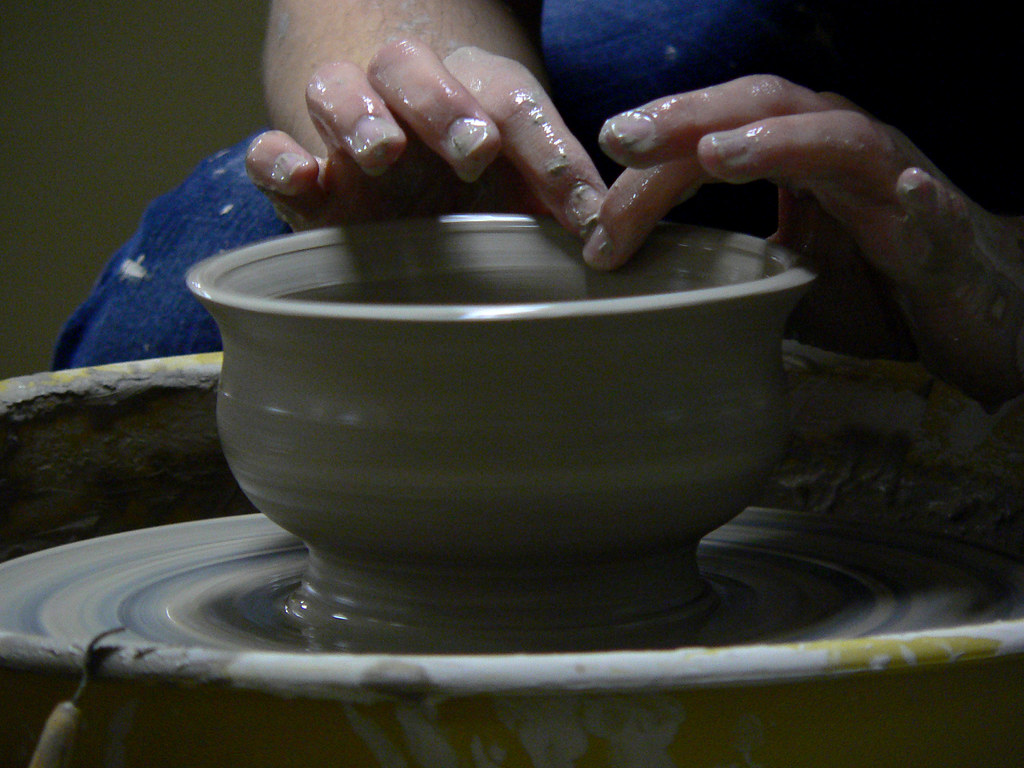
potter hands

I walk this line between incoherent creative overflow and paralyzing perfectionism. More accurately, I seem to hop back and forth over line. I don't actually get much contact with it. I believe that would be called balance. Yeah. Don't have much of that right now.

As a writer of both non-fiction and fiction, I find that I use different skills for different projects. I fight myself into structure and plotting in my fiction, jump into the story and watch it blow up around me as I run pell-mell through things and throw out my plans as some new angle appears. It's a wild ride when I abandon all editing techniques because if I stop to even fix stuff like spelling, I get stuck. My feet sink into that other side of the line. Perfectionism. Even a sentence can turn into an hour long project. I can't risk getting there or I will NEVER FINISH my first drafts.

Usually with non-fiction, this isn't such a struggle. I make an outline and then write it out. Until this time.

I'm being sucked down this drain in to the darkness of anxiety and perfectionism. What if I write the wrong thing?

I know I need to write! I've felt inspiration, the pulling tug of God telling me this is something He would like me to do. It will make a difference to someone.

But instead of writing I binge watch Chinese romantic dramas.

Last week I told myself I had to get on top of this. Instead of writing, I grabbed my scriptures, searching for inspiration.

The book fell open to Jeremiah 18:2-6.

"Arise, and go down to the potter's house, and there I will cause thee to hear my words. 
Then I went down to the potter's house, and, behold, he wrought a work on the wheels. 
And the vessel that he made of clay was marred in the hand of the potter: so he made it again, another vessel, as seemed good to the potter to make it. 
Then the word of the Lord came unto me saying, 
O house of Israel, cannot I do with you as this potter? saith the Lord. Behold, as the clay is in the potter's hand, so are ye in mine hand, O house of Israel."

Okay. It was almost funny in a way.

Regardless of what this was originally intended to mean, for me, that night, it was suddenly clear that the Lord was telling me to stop being afraid of doing the wrong thing and to just write! I needed to get something down and then, like the potter, couldn't I fix my mistakes later? Wasn't I in the Lord's hands? Couldn't he show me how to fix things too? But not if I didn't put something down first. I had to write.

That's my goal now. I tell myself: "Put something down. We can fix it later." And honestly, if God is going to be one of my editors, things will work out just fine.

Tuesday, March 7, 2017

Hospital Waiting Room


               Television always plays more commercials than entertainment. At least that’s what it feels like in the hospital waiting room.
               My husband had been back in surgery for thirty minutes before I finally felt comfortable looking around the room. My straight spine relaxed into the chair and I turned my neck this way and that, clicking as I rotated it around on my shoulders.
                The CT scans had come back clear, the best news of today. So if the irregularity was cancerous, at least it was contained, for now.  But for thirty minutes, I could not shake the agitation of expecting the worst. What if my husband contributed to the small percentage of people who had severe complications? What if he added to the mortality rate? Those statistics were a reality for someone.
                I remembered our last kiss. Was it the last time I would feel his lips respond to mine? My fingers had wrapped around the back of his head, pulling his face closer, pressing with more strength, lingering even though the anesthesiologist waited.
A good man, our pain doctor, cheery. A family friend. When he texted that he changed his day’s schedule so that he could take care of Dustin, I brushed away the tears. Such a kind gesture.
He gave Dustin a short-term amnesia-causing drug. But my fun husband wanted to remember. So I chuckled, as his face twisted in concentration, an effort to imprint his journey to the operating room, determined to beat the meds. Comforted by my spouse’s never-ending good nature, my heart warmed as he rolled down the hallway.
                Good memories to turn over and around in my mind now that I sat here waiting. Much better than the what-if questions that plague me in the middle of the night. Better than discussing our life insurance plans and making contingency preparations. He would live. He knew it. I knew it. But I worried about complications.
                My comfort in the waiting room increased enough that I began to study my fellow wait-ers. People who would never normally be together, brought to share the same space in difficult circumstances, we participated together in sometimes trying news. As each doctor arrived to share the results of surgery, the rest of us pretended we didn’t hear the prognosis. But it was difficult to ignore, “If he smokes again, even one more pack, he will die.” Or the “I’ve done all I can. At this point, we watch and wait and hope for the best.”
                When our friend-anesthesiologist stepped in to greet me, gone were the clinical patient/doctor lines. He embraced me. “It looked great. He’s doing well. They will call you back as soon as they get him out of recovery.” And he explained a couple important details.
Relief filled me.
Life might be different than we’ve ever known it to be from here on out, but it was life. And life could be lived, adapted, tried, failed, conquered, but most importantly, lived.


Thursday, March 2, 2017

Breaking a revision rut

Me, "cutting" my cake at The Spanish Exile book launch
Lately, I have been reveling in a whirlwind of creativity. Since November 2016, I have published two books -- about as different from each other as you could get. The first is a political memoir called Soapbox: How I landed & lost a columnist gig, fought a prison, and got elected. The second is the first of a 4-book swashbuckling historical series, The Spanish Exile, which I launched last week.

The Spanish Exile started as a glimmer of an idea clear back a decade ago. Before its publication, I started a memoir publishing company (Treasured Stories), self-published my first novel (Ghost Moon Night), got elected to city council, and put out my memoir. Finally this year, I decided, no more digressions; it was high time I got this series off the ground.

However, in the past, my publishing process stalled at revision. I just couldn't muscle my way through a hot manuscript mess. I decided to overhaul my process, so I could overcome that I-can't-revise psychological hurdle. Here are some things that helped me through that revision rut:

1. Write a synopsis and blurb. I wrote a 7-page chapter by chapter synopsis then hired someone to write an exciting blurb...and revised to that. Some people detest synopses. Relax. It doesn't have to be literary or even pretty. You are just cataloguing your plot, to test it for holes and give you the lay of the land. As for a blurb, I could have muddled my way through it, or, for the price of a nice dinner for two, I hired a talented blurb writer.

2. Recruit cheerleaders. These are readers and writers who like the kind of stories you write. If you get a fantasy reader for your nonfiction, most likely, their feedback will be a downer. I had a cheerleader, my 16 year old voracious reader daughter, who brainstormed solutions to my plot holes. She kept me going and kept my pace exciting. Which meant my story was less boring, making it more exciting to work on. This recharged my creativity.

3. Set specific and challenging goals and track your progress. Sure, I could have revised an hour here and there. Instead, I revised in marathon sessions with specific page number goals that I announced to an accountability group. If midnight rolled around, I stuck to my guns until I finished into the wee hours just to say I did it.

4. Minimize distractions. I transformed my office into a writing "cave", closing my blinds, immersing in instrumental cello music, wrapping myself in blankets, closing my door if need be. Kind of writing in a cocoon, turning into a butterfly later.

5. Get a print copy of the book. I formatted my draft into a Createspace book which inspired me, then made corrections on the book. Oh my, that was a little disheartening seeing all those scribbles on every single page...

6. Keep going. But I persisted one page at a time and revised it in the final format, so it felt like progress. The book will eventually end, so hang in there.

7. Focus. I resisted signing up for conferences and contests and focused on getting my book done. I kept my schedule as open as possible for writing in long stretches. I asked my already sweet helpful family to pitch in on household chores and to cook dinner if they wanted to eat.

8. Acknowledge difficulties but don't wallow. I allowed myself to cry a little, "Wah, this is tough!" then went back to work. I asked more expert writers for help with specific problem spots. I watched YouTube videos on revising and writing.

9. Pray. I prayed for help. A lot.

Now that momentum is on my side, I intend to capitalize on it. I am revising Book 3 and plan to complete the series by September.

Jewel Allen is an award-winning journalist, author and ghostwriter. She is the author of The Spanish Exile and The Last Princess, the first two books in a swashbuckling historical series, Islands of the Crown. Visit her at www.jewelallen.com.